Single-Electron Counting Statistics
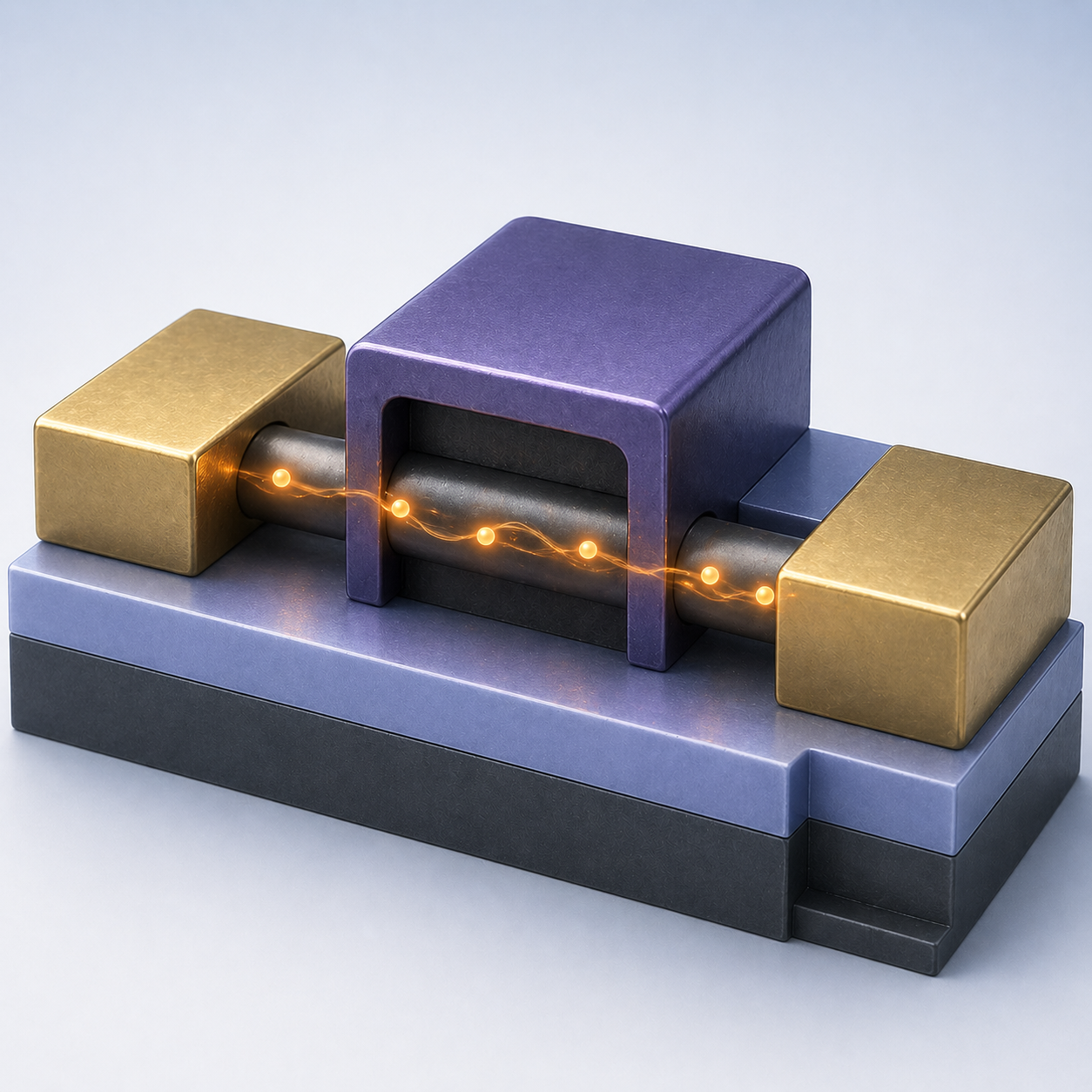
Single-electron counting statistics, obtained by monitoring individual electron motion, provide a powerful tool to analyze the stochastic nature of electron transport in mesoscopic systems. In conventional current measurements, electron flow is averaged over time, and the underlying stochastic dynamics are obscured. In contrast, counting the number of electrons passing through a device within a given time interval allows direct access to these fluctuations and enables quantitative evaluation of quantities such as entropy production, providing a platform to test stochastic thermodynamics. We have constracted a single-electron counting system based on nanometer-scale transistors and applied it to various mesoscopic systems. While most single-electron counting experiments are performed at low temperatures to control and detect one electron, our approach operates at room temperature and focuses on multi-electron dynamics. This enables, for example, the exploration of rare fluctuation events in Gaussian statistics and opens the possibility of observing new physical phenomena by accessing large statistical datasets. These capabilities make counting statistics an essential tool for investigating stochastic thermodynamic processes.
Energy Decomposition and Optimization in Non-Equilibrium Electronic Devices

This situation is analogous to energy dissipation in electronic devices operating under non-equilibrium conditions.
Electronic devices operate under non-equilibrium conditions, where continuous energy input is required to generate and control signal flows such as electric current. In such processes, there exists a minimum amount of energy that is intrinsically required, while additional, avoidable energy dissipation arises depending on how the system is driven. Understanding and minimizing this excess energy consumption is a central issue in non-equilibrium thermodynamics, yet both optimal driving strategies and their quantitative evaluation remain nontrivial. Here, we aim to use single-electron counting statistics to decompose the energy consumption in electronic devices into distinct components associated with their physical roles. By analyzing the stochastic dynamics of electron transport, we seek to identify the portion of energy dissipation that is fundamentally required and the part that can be avoided. Based on this decomposition, we aim to establish design principles to minimize unnecessary energy consumption and improve the efficiency of non-equilibrium electronic devices.
Stochastic Pumps: Fluctuation- and Phase-Controlled Information Transport

Single-electron counting statistics, obtained by monitoring the motion of individual electrons, provide a powerful approach to analyzing the stochastic nature of electron transport in mesoscopic systems. In conventional current measurements, electron flow is temporally averaged, making the underlying stochastic dynamics difficult to access. In contrast, by counting the number of electrons passing through a device within a given time interval, one can directly probe these fluctuations. Counting at the single-electron level establishes an absolute scale based on the elementary charge, enabling quantitative and high-precision evaluation of physical quantities such as entropy production, and providing a platform for testing stochastic thermodynamics. We have developed single-electron counting systems based on nanometer-scale transistors and applied them to analyze statistical properties of electron transport in real devices. While single-electron counting experiments are typically performed at low temperatures, our approach operates at room temperature and focuses on many-electron dynamics. This enables access to large fluctuations and collective behavior that are difficult to capture in conventional single-electron systems, and opens a pathway to exploring stochastic thermodynamics under conditions closer to real-world environments.
Stochastic Resonance in Single-Electron Systems
Stochastic resonance (SR) — where adding noise paradoxically enhances signal detection — is well established in continuous systems described by Langevin equations. However, whether the same physics governs discrete, single-electron systems remains an open question. Two aspects make this non-trivial. First, in single-electron devices, shot noise arising from the inherently random, Poissonian transfer of individual electrons acts as a "built-in" noise source, causing a fundamentally different situation from classical SR based on external noise injection. Second, when the charging energy for one electron to be added to a nanoscale capacitor exceeds the thermal energy, electron fluctuations are suppressed or amplified due to charge quantization. This effective suppression/amplification of noise would need an extended theoretical framework for SR. Our laboratory aims to experimentally map out SR behavior in single-electron circuits, clarifying whether new physics emerges at this discrete electronic frontier.
Electrical Injection into Excited Electronic States
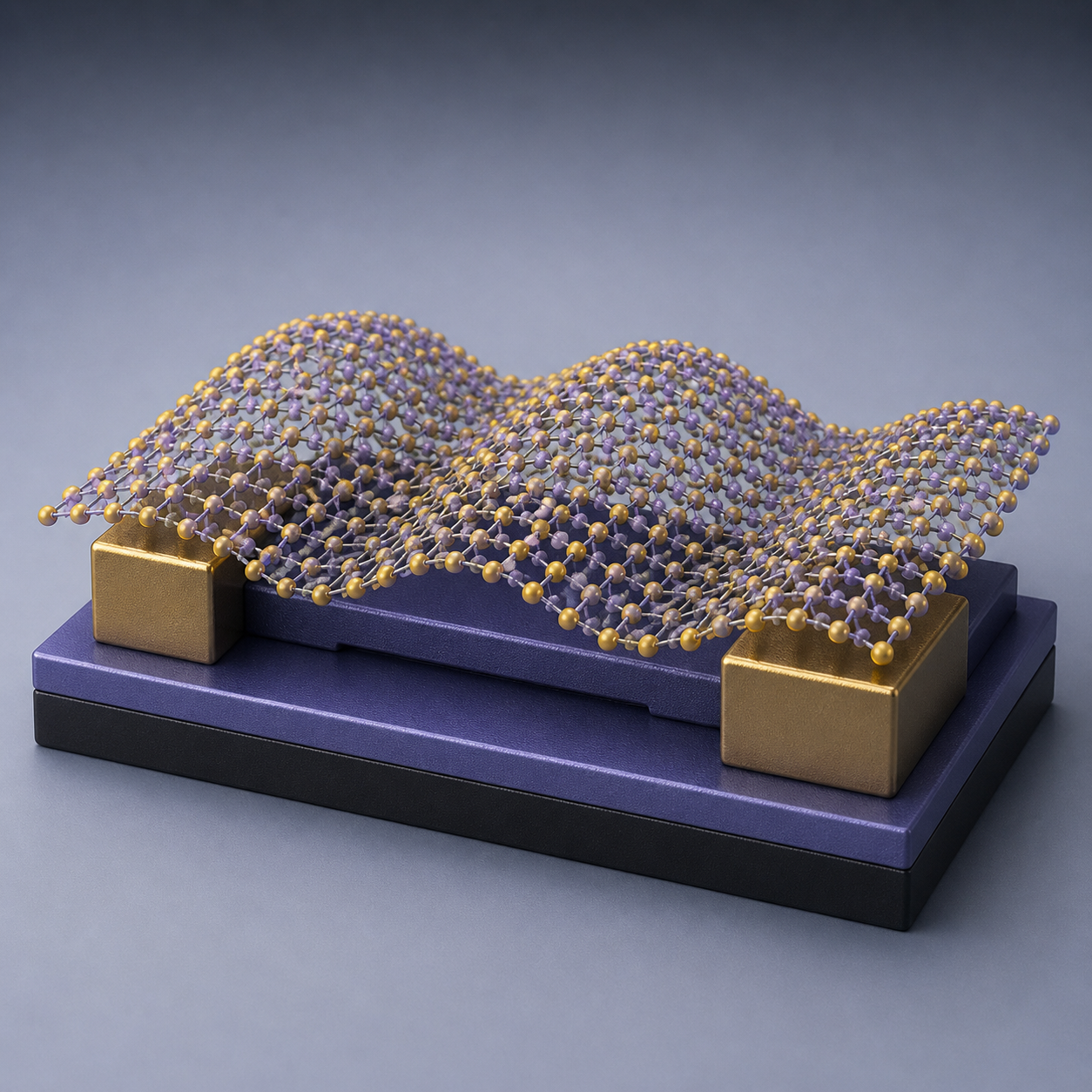
Non-equilibrium conditions provide access to electronic states that are not available in equilibrium systems. In conventional electronic devices, current is carried by electrons and holes near the band edge — leaving higher-energy subbands essentially inaccessible. While photoluminescence studies hint at rich optical and electronic properties in those subbands, direct electrical injection of carriers into excited states has remained out of reach. Our laboratory explores a new route based on a novel silicon transistor architecture that enables injection of hot carriers — energetically excited electrons and holes — into two-dimensional layered materials. This approach inherently exploits "non-equilibrium carrier dynamics", giving access to subbands and direct-gap transitions that are otherwise electrically inactive. Subband structure can also be probed in a manner similar to scanning tunneling microscopy, and the platform allows measurements under a wide range of conditions including low temperature and magnetic fields. Our goal is to realize, in solid-state devices, phenomena that were previously confined to optical experiments.